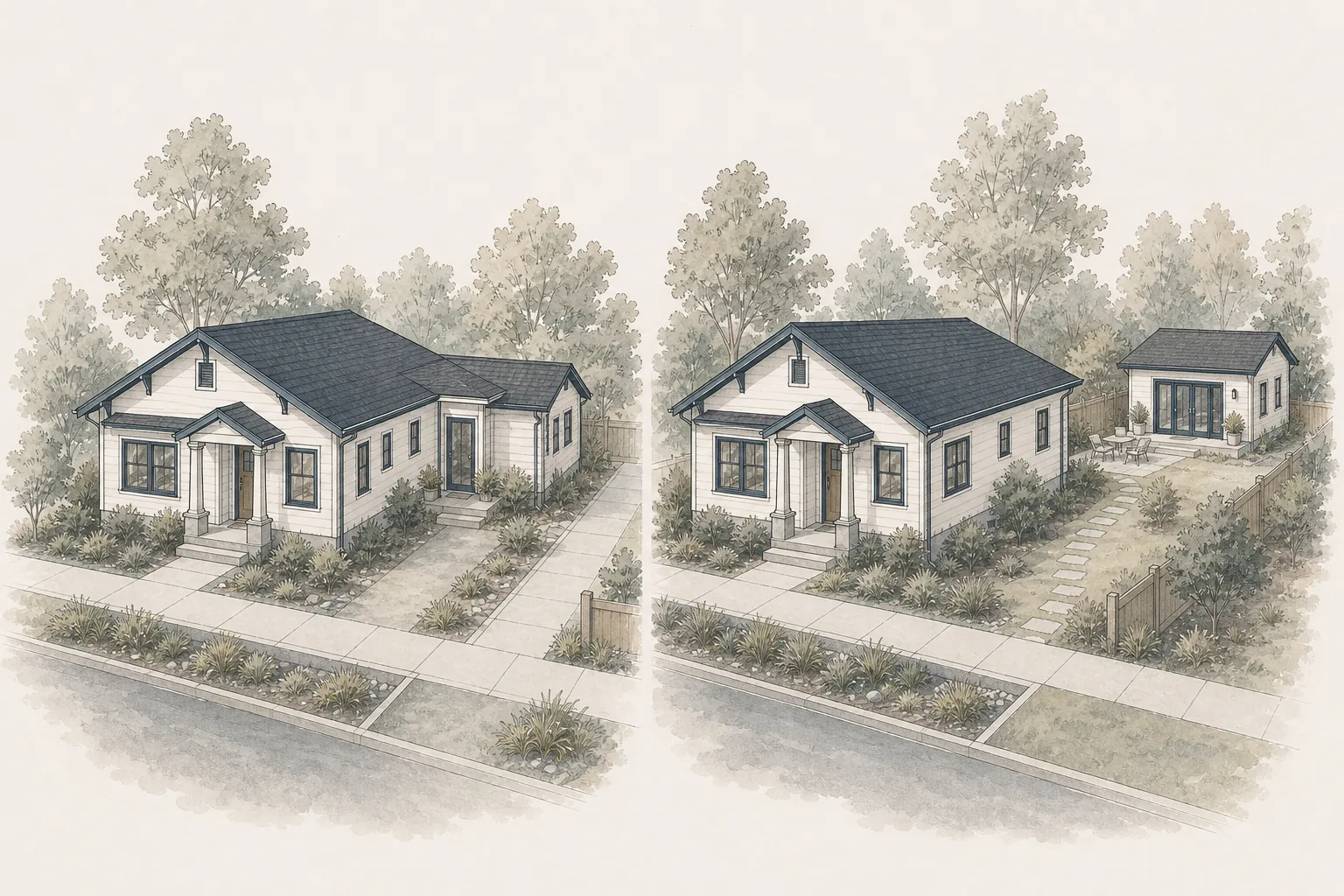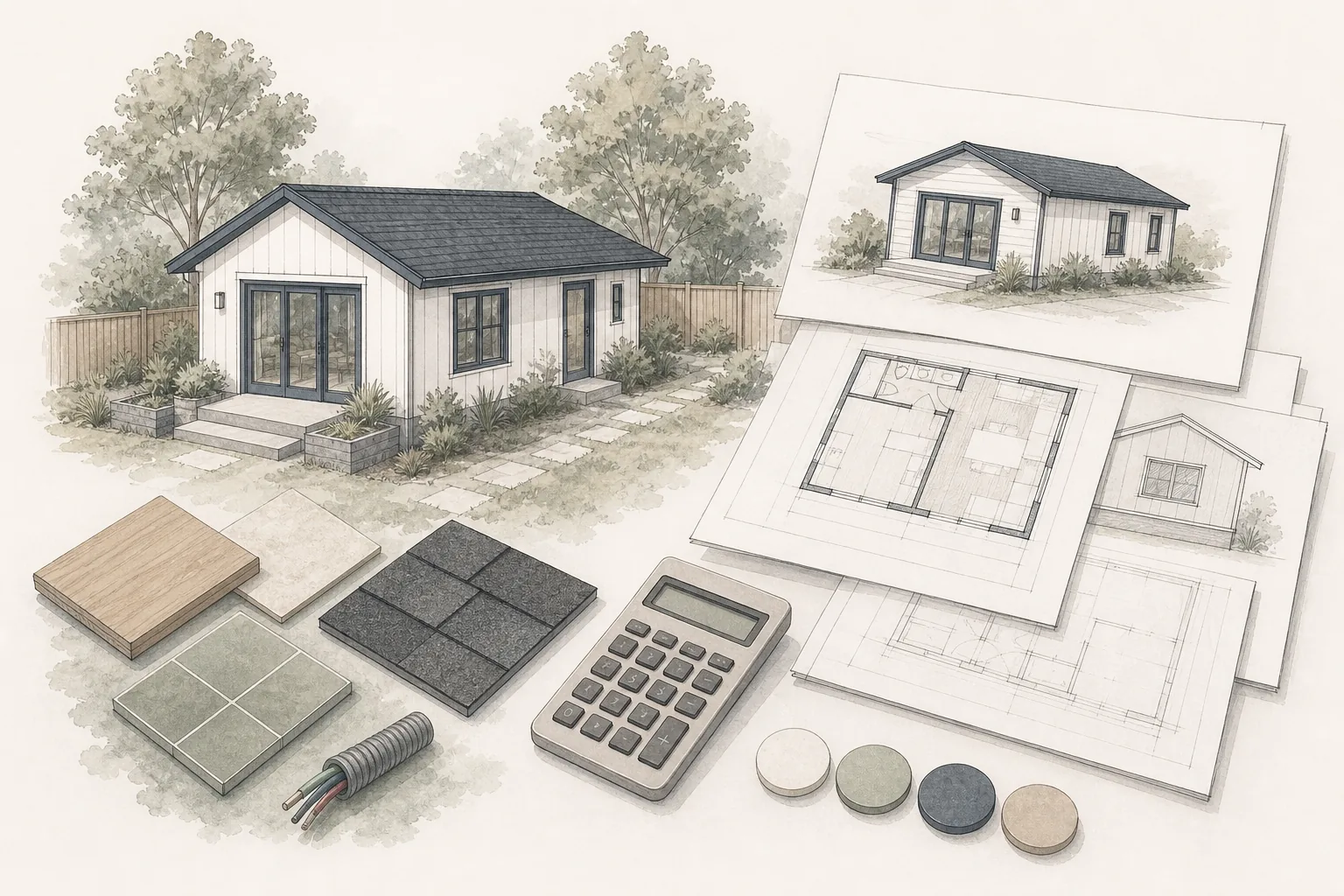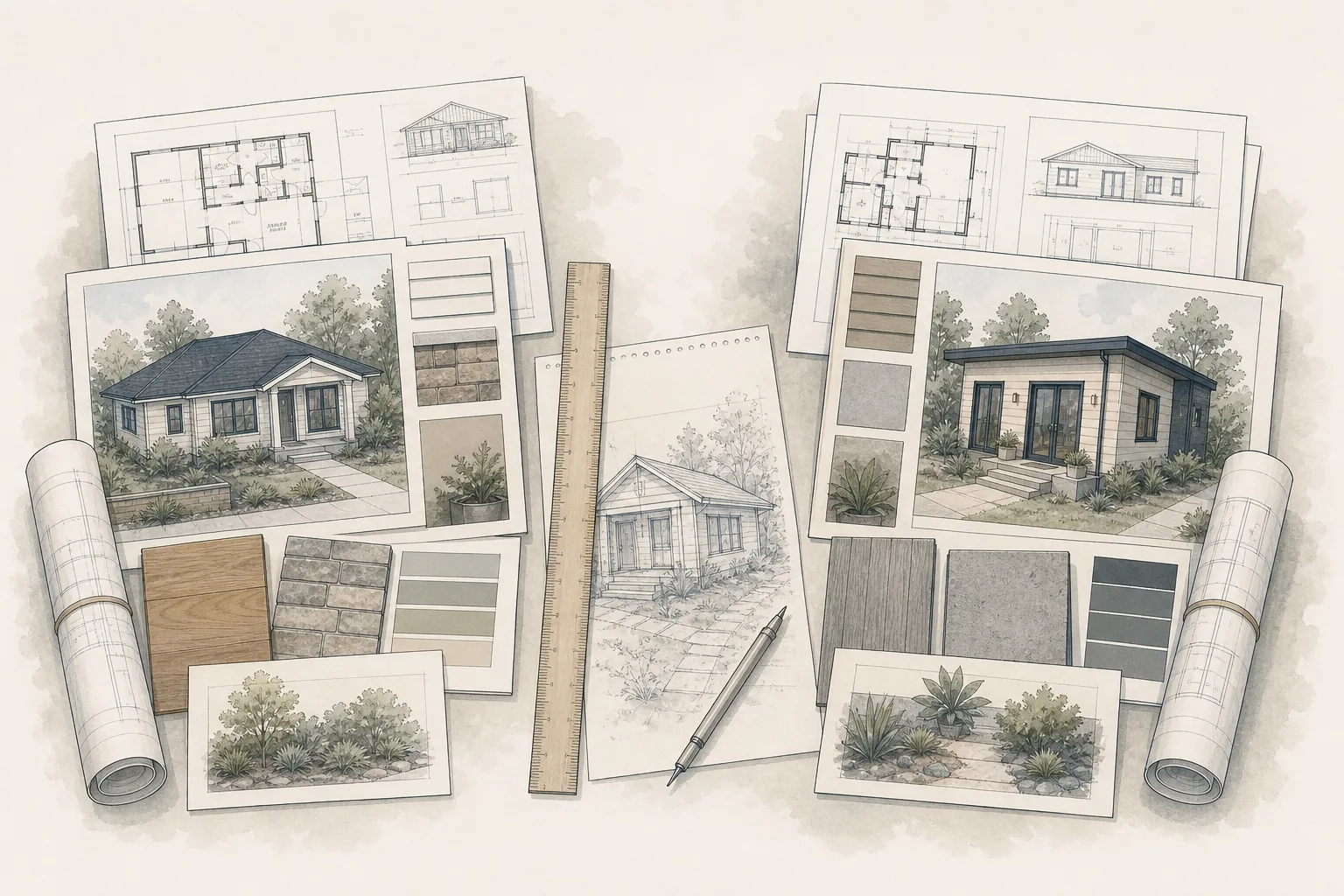
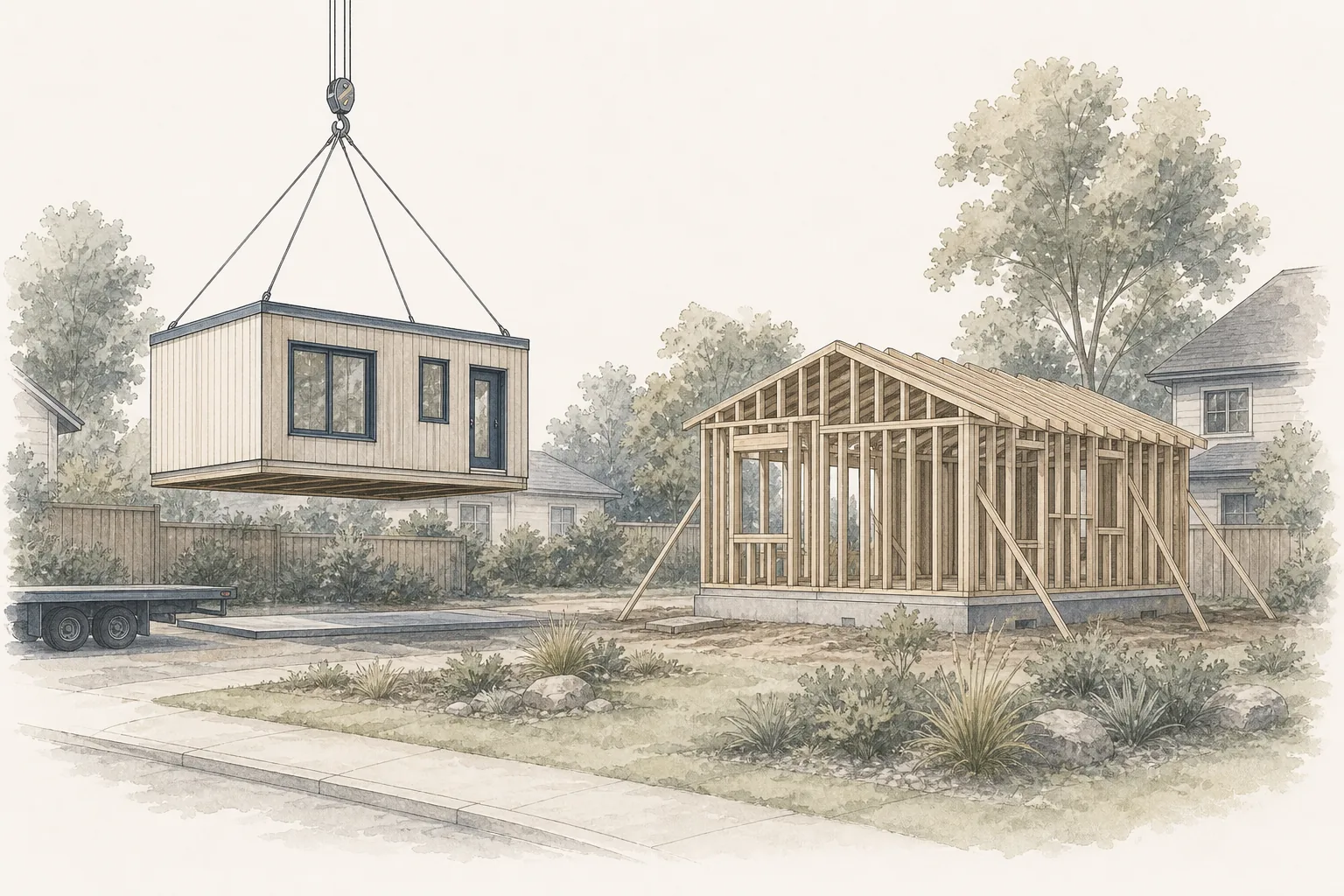
A prefabricated ADU is not automatically less expensive, faster or simpler than a site-built ADU.
Prefab construction may reduce portions of on-site building work, while site-built construction may provide greater flexibility for the property and homeowner’s goals. The better option depends on the complete installed project—not only how the structure is produced.
Before choosing either approach, confirm that the jurisdiction will accept the proposed construction type and compare design, approvals, site work, utilities, delivery, installation, contracts and owner responsibilities.
What Is the Difference Between a Prefab and Site-Built ADU?
A site-built ADU is constructed primarily on the property using conventional on-site building methods. Materials and components are delivered to the site, and the structure is assembled in its final location.
A prefabricated ADU is produced partly or substantially away from the property and then delivered as components, panels or modules for installation. The word “prefab” describes a broad category rather than one standardized product.
The amount of work completed off site varies. One system may arrive as wall panels, while another may arrive as one or more substantially completed modules. Those differences affect transportation, inspection, installation, responsibility and the remaining work required at the property.
Prefab, Modular, Manufactured and Pre-Approved Are Not the Same
Homeowners may encounter several terms that appear interchangeable but describe different things.
- Prefabricated describes construction that occurs partly or substantially away from the project site.
- Panelized systems arrive as building components that are assembled into the final structure on the property.
- Modular systems generally arrive as larger building sections that are joined and completed on site.
- Manufactured housing follows a separate regulatory and construction framework that may differ from modular or site-built housing.
- Pre-approved plans are building plans reviewed through a particular government program; they may be site-built or prefabricated.
A pre-approved plan is not automatically approved for every property. Site placement, foundations, utilities, grading, fire access and other property-specific conditions may still require review.
Ask the manufacturer, designer and local permitting authority to identify exactly which construction classification, approvals and inspections apply to the proposed unit.
Not Every Jurisdiction Accepts Every Prefab ADU
Prefab and factory-built ADUs are not accepted in every jurisdiction or under every local approval process.
A product may have state-level or third-party approvals and still require local review for zoning, site planning, foundations, utility connections, installation and other work performed on the property. Some jurisdictions may restrict particular construction classifications or require documentation that a proposed manufacturer cannot provide.
Before paying a design deposit or ordering a unit, confirm:
- Whether the jurisdiction accepts the proposed construction type
- Which agency reviews the factory-built portion
- Which agency reviews the site-specific work
- Whether the plans or approvals can be used at the specific property
- Which local amendments, design standards or overlays may apply
- How inspections will be divided between factory and site work
California widely accommodates factory-built housing through a state regulatory framework, but local permits and inspections still apply to installation and site work. Homeowners elsewhere should not assume that a product marketed nationally can be approved in their municipality.
How Should You Compare Prefab and Site-Built ADUs?
1. Fit with the property
A repeatable prefab plan may work well on a property with a compatible building area, straightforward access and manageable utility routes.
An irregular lot, steep site, constrained access, unusual setbacks, existing structures or important landscape features may require more adaptation. Site-built design can respond more directly to those conditions, although some prefab systems offer limited customization.
2. Design flexibility
Site-built construction generally offers more freedom to adjust the footprint, openings, roof form, layout and relationship to the primary home.
Prefab systems typically work within a manufacturer’s structural, transportation and production limits. Standardization can simplify decisions, but modifications may reduce the advantages of the system or require additional engineering and review.
Compare the available plan to the intended use. A design that does not support privacy, furniture, storage, accessibility or long-term flexibility is not a good value simply because it is easier to order.
3. Permits and technical coordination
Both approaches require property-specific approvals. The difference is how responsibility is divided.
A site-built team may coordinate the building and site documents as one permit package. A prefab project may combine manufacturer documents with separate foundation, site, utility and installation documents.
Confirm who will assemble the complete submittal, respond to permit comments and coordinate revisions when the factory documents and local requirements do not align.
4. Site work, foundations and utilities
Prefab changes where part of the building is produced. It does not eliminate the property.
The project may still require demolition, grading, drainage, foundations, retaining work, trenching, water and sewer connections, electrical upgrades, access improvements, landscaping and restoration.
These costs can be significant and may not appear in the advertised unit price. Compare the complete installed project rather than the factory package.
5. Transportation, delivery and installation
Prefab projects introduce logistics that site-built projects may not have. The budget and schedule may need to address transportation dimensions, route restrictions, permits, staging, cranes, overhead lines, street access and temporary removal of property improvements.
A unit that can be manufactured successfully is not necessarily easy to deliver to the final location. Confirm the proposed route and setting plan before treating delivery as a fixed or routine cost.
6. Schedule
Factory production and site work may sometimes proceed at the same time, which can reduce on-site duration. Controlled production can also limit exposure to weather during portions of the build.
The total project schedule still includes feasibility, design, approvals, site preparation, foundation work, utility coordination, manufacturing availability, delivery and final connections. A short factory production period does not represent the complete timeline.
Site-built construction may spend more time on the property, but the work can sometimes adapt more easily when site conditions or local requirements change.
7. Cost and price certainty
A standardized building package may make one portion of the cost easier to understand. It does not necessarily create certainty for the full project.
Compare the same scope for both options, including design, engineering, permits, fees, site work, foundations, utilities, transportation, crane or setting operations, installation, finishes, exterior work, restoration and contingency.
Also confirm what could change the manufacturer’s price, including plan modifications, finish selections, escalation, storage, delivery conditions and schedule delays.
8. Quality control and field coordination
Factory construction can provide repeatable processes and protection from weather during production. Site-built work allows the building to be assembled in its final context and may make field adjustments more direct.
Neither method guarantees quality. Review the manufacturer’s or builder’s experience, inspection process, warranty responsibilities and procedures for correcting work that does not fit or perform as intended.
9. Contracts, responsibility and warranties
A site-built project may place most construction responsibility under one general contractor. A prefab project may involve separate agreements for design, manufacturing, transportation, foundations, installation, utilities and site completion.
Multiple contracts are not automatically a problem, but the interfaces must be clear. Determine who is responsible if dimensions conflict, delivery is delayed, the foundation is out of tolerance, a module is damaged or local corrections affect factory work.
Confirm how warranties are divided and who will respond after completion.
10. Financing, insurance and appraisal
Financing, insurance and appraisal treatment may depend on the construction classification, contract structure, payment schedule, foundation, installation and local market.
Discuss the specific product and delivery method with the appropriate lender, insurer and appraisal professionals before committing. Do not assume that every prefab product will be treated the same as a site-built dwelling.
When Might a Prefab ADU Be a Strong Fit?
A prefab option may deserve serious consideration when:
- The jurisdiction accepts the proposed system
- A standard plan fits the property and intended use
- The site has a workable delivery and setting route
- Foundations, utilities and site responsibilities are clearly defined
- The homeowner values a more limited menu of design decisions
- The manufacturer and local project team have a proven coordination process
The decision should be based on verified project fit rather than a generic promise of speed or savings.
When Might a Site-Built ADU Be a Strong Fit?
A site-built option may be better suited when:
- The lot requires a highly specific footprint or building form
- The design must respond closely to privacy, views or existing architecture
- Delivery or crane access is difficult
- The homeowner needs substantial layout customization
- Local contractors are better positioned to coordinate the complete scope
- The project is likely to require field adaptation as conditions become known
Greater flexibility can be valuable, but it should be supported by complete documents, clear scope and disciplined decision-making.
Questions to Ask a Prefab ADU Company
- What construction classification and code framework applies to this product?
- Has this exact system been approved in my jurisdiction?
- Which approvals are included, and which remain the homeowner’s responsibility?
- What site, foundation and utility information is required before ordering?
- What is included in the advertised price?
- Who provides transportation, crane service, installation and final connections?
- What site conditions can change the price or schedule?
- Who coordinates permit comments involving both factory and site documents?
- What deposits become nonrefundable, and when?
- How are damage, dimensional conflicts, corrections and warranty claims handled?
Questions to Ask a Site-Built ADU Team
- Who is responsible for feasibility, design and permit coordination?
- How will site access, utilities and existing conditions be investigated?
- Which parts of the scope are allowances or exclusions?
- How are design decisions tied to the budget?
- What experience does the team have with comparable ADUs and constrained properties?
- How will changes, inspections, quality control and closeout be managed?
Frequently Asked Questions
Is a prefab ADU always cheaper than a site-built ADU?
No. A factory package may reduce or standardize part of the building cost, but the total project still includes design, permits, site work, foundations, utilities, delivery, installation and restoration. Compare complete installed scopes.
Is a prefab ADU always faster?
No. Factory production may shorten part of the construction process, but the overall schedule also depends on feasibility, permitting, manufacturing capacity, site preparation, delivery access, utilities and final inspections.
Can any prefab ADU be installed in any city?
No. Acceptance varies by jurisdiction and construction type. Confirm the proposed system with the local permitting authority before ordering or making a nonrefundable commitment.
Does a prefab ADU still need a foundation and utilities?
Usually, yes. The foundation, utility connections and other site work remain property-specific even when much of the building is produced elsewhere. The exact requirements depend on the product and jurisdiction.
Are pre-approved ADU plans the same as prefab ADUs?
No. Pre-approved describes the review status of a plan within a particular program. The building may be site-built or prefabricated, and the property still requires site-specific review.
Which ADU type is better for a difficult lot?
It depends on the constraint. A custom site-built design may adapt more easily to an irregular footprint, while some prefabricated systems may work if the building area and delivery route are compatible. Evaluate the site before selecting the construction method.
How Foundation Can Help
Foundation Renovation Coaching helps homeowners compare prefab and site-built ADU options before committing to a manufacturer, designer or contractor.
That may include:
- Clarifying goals and property constraints
- Organizing jurisdictional and permitting questions
- Comparing complete installed scopes
- Identifying missing site, utility and logistics costs
- Reviewing exclusions, assumptions and owner responsibilities
- Preparing questions for manufacturers, designers and builders
Foundation does not design, engineer, permit, manufacture, appraise, finance or construct ADUs. The role is to help homeowners understand the decision, organize the available information and identify what still needs to be verified.
Compare the Whole Project, Not the Label
Prefab and site-built are methods of delivering an ADU. Neither label determines whether the project is feasible, complete or well managed.
The better choice is the option that fits the property, intended use, jurisdiction, budget, schedule and available project team—with responsibilities clearly assigned from design through final connection.
Jurisdiction Note
ADU rules, construction classifications, permit processes and inspection responsibilities vary by location and change over time. Confirm the proposed system and property-specific requirements with the applicable agencies and qualified project professionals before making a purchase or contractual commitment.
Related Foundation Articles
KB-2701 — Is an ADU Right for Your Property and Goals?
KB-2708 — How to Evaluate Your Property for an ADU
KB-2725 — How Much Does an ADU Cost?