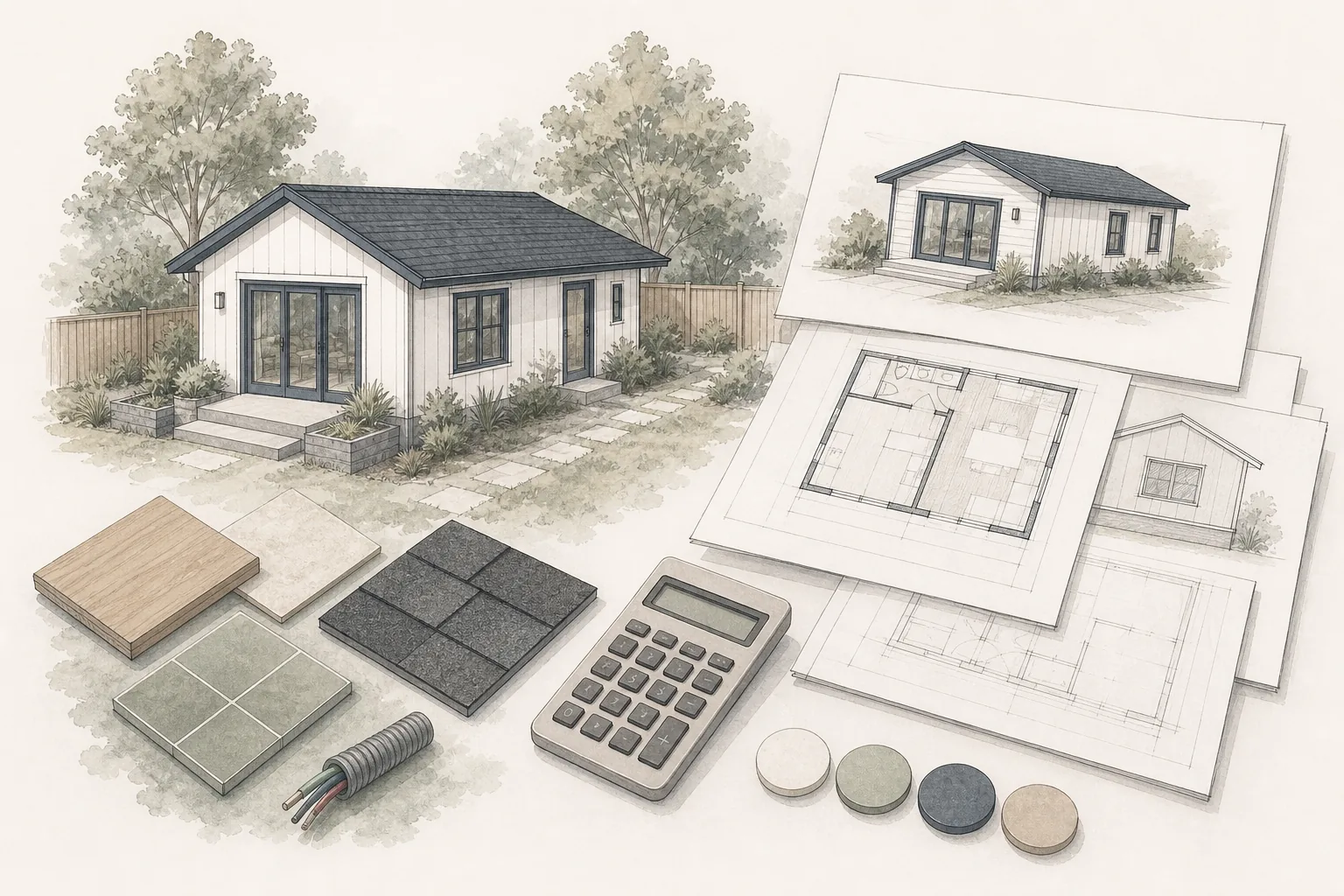
A realistic ADU budget includes more than the price of the building.
It should account for the work required to determine whether the project is feasible, prepare and approve the design, connect the dwelling to the property, construct it, restore affected areas and manage uncertainty.
The most useful budget is not a single early estimate. It is a living project document that separates confirmed costs from allowances, assumptions, exclusions and unresolved questions.
Start With the ADU You Are Actually Planning
Before assigning numbers, define the project well enough that the budget has a clear basis.
At minimum, identify:
- The intended use of the ADU
- Whether it will be detached, attached or created through a conversion
- The approximate size and level of finish
- The likely location on the property
- How occupants will enter and use outdoor space
- How water, sewer, power and other systems may connect
- Which work the owner expects the designer, builder or manufacturer to provide
If these decisions remain open, the budget should show them as assumptions rather than treating them as settled facts.
What Should an ADU Budget Include?
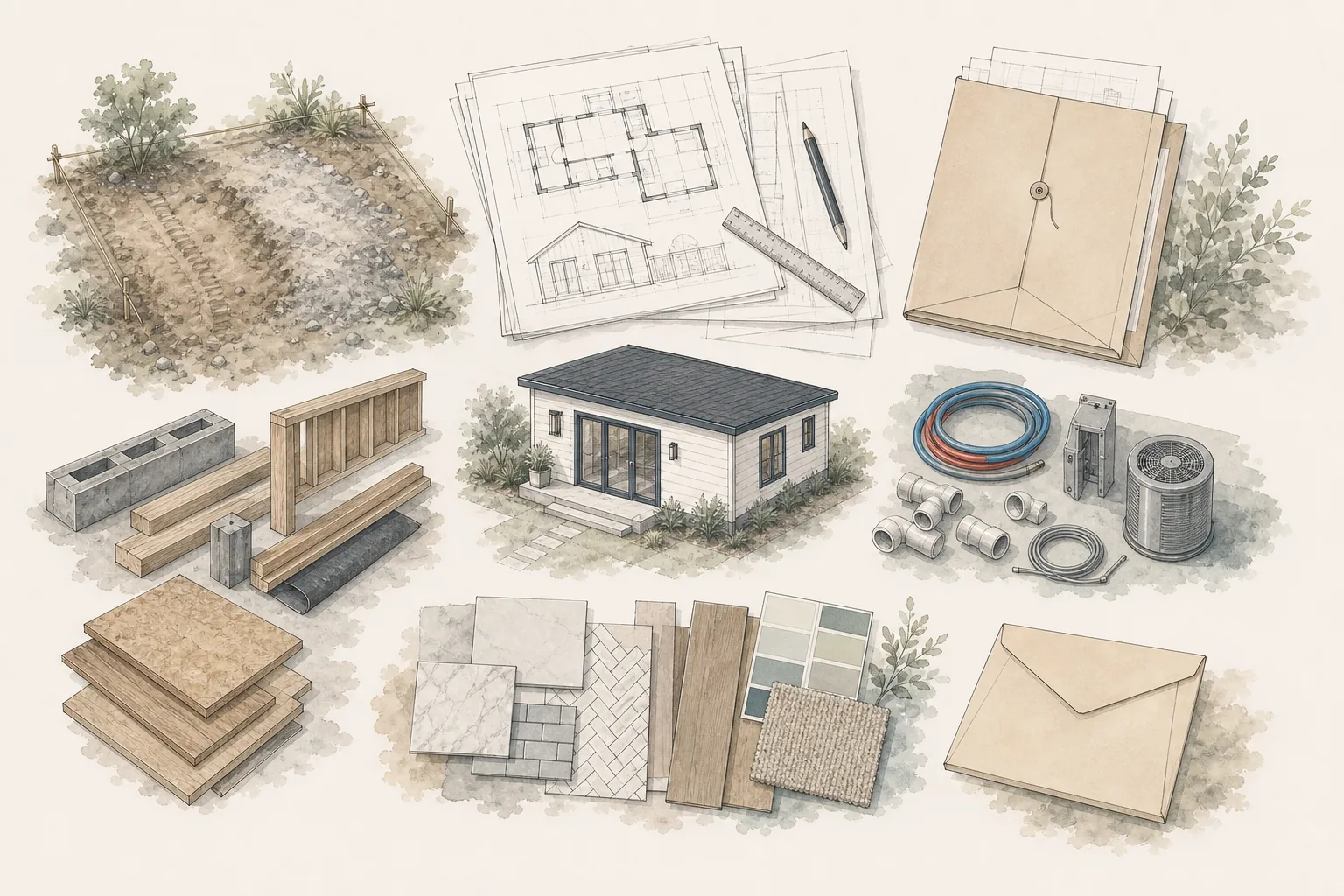
An all-in ADU budget should organize the project into categories that extend from early feasibility through final closeout. The exact categories will vary, but most homeowners should investigate the following areas.
1. Feasibility and property investigation
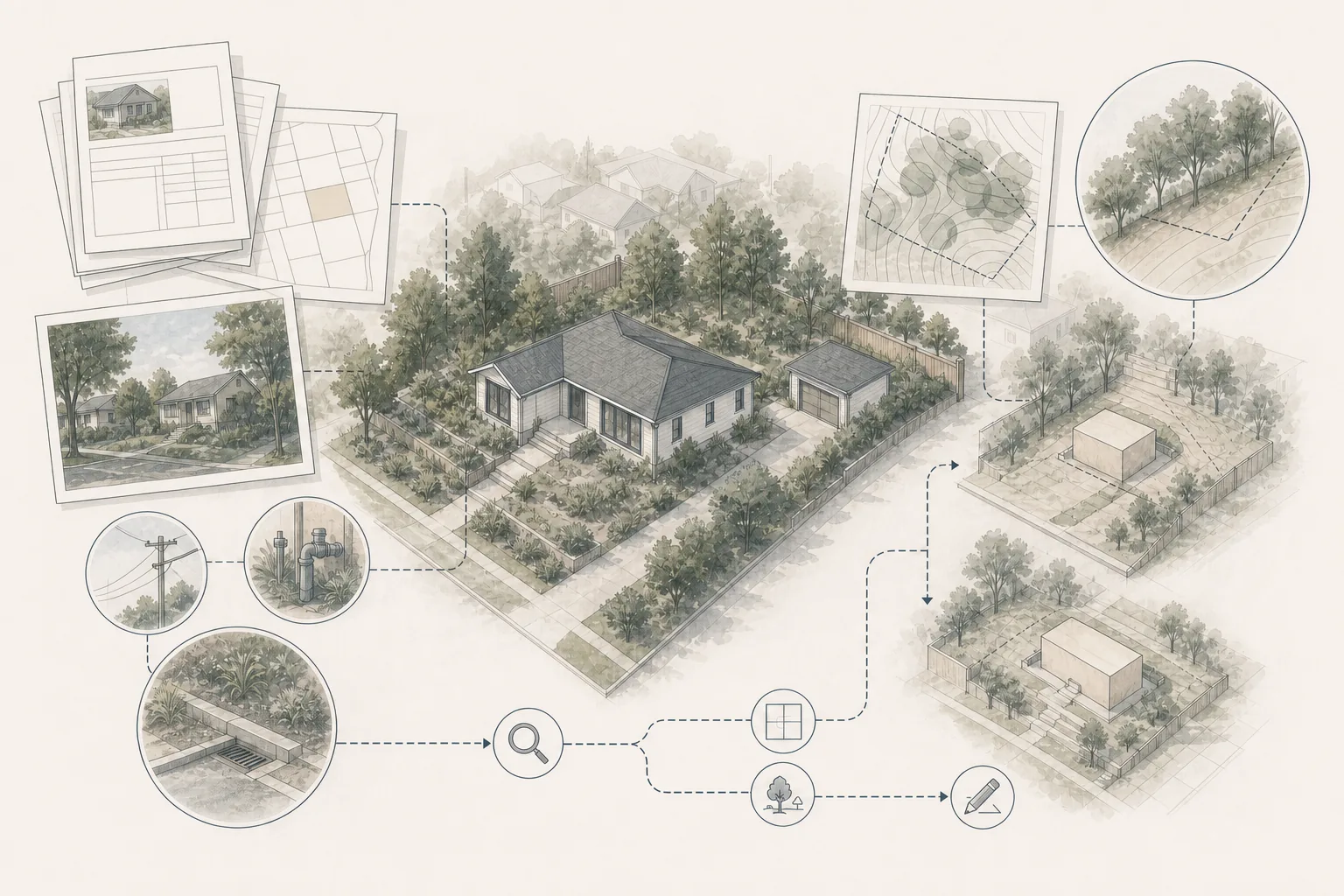
Budget for the work needed to understand the property before the design is fully developed. This may include property research, zoning review, measurements, surveys, record searches, utility research, soils information, existing-building investigation or other site-specific studies.
Early investigation does not eliminate every surprise. It helps identify which conditions are known, which are likely and which still require an allowance or contingency.
2. Design, engineering and technical documentation
The design budget may include architecture or residential design, structural engineering, civil engineering, energy documentation, landscape or drainage input and specialty consultants.
A simple-looking ADU can still require coordination among several disciplines. Confirm who is responsible for preparing, coordinating and revising each part of the permit and construction documents.
3. Permits, reviews and agency costs
Include the permits, plan-review charges, utility reviews, impact or development fees and other agency costs that may apply in the jurisdiction.
Do not assume every agency charge is included in a designer’s or contractor’s proposal. Confirm which fees are included, which will be paid directly by the homeowner and which cannot be determined until the project is further developed.
4. Site preparation, access and property protection
The building footprint is only one part of the construction area. The budget may also need to address demolition, clearing, excavation, grading, drainage, retaining work, tree protection, temporary fencing, access protection, material staging and restoration.
Restricted access can affect labor, equipment and delivery costs. A rear-yard project may require smaller equipment, additional handling or temporary removal and replacement of property improvements.
5. Utility connections and system upgrades
Budget separately for water, sewer, electrical, gas, communications and any required service or capacity upgrades.
Utility costs depend on routing, distance, elevation, trenching, existing capacity, connection points, meters, panels, pumps and the improvements that must be disturbed and restored. A line shown on a preliminary plan is not the same as a verified scope of work.
6. Building construction
The construction budget should cover the complete installed building rather than only the visible structure. Depending on the project, this may include foundations, framing, roofing, exterior finishes, windows, doors, insulation, drywall, interior finishes, cabinets, countertops, plumbing, electrical, heating, cooling, ventilation and required life-safety systems.
Ask whether the proposal includes general conditions, supervision, temporary facilities, cleanup, testing, inspections, contractor overhead and other costs required to deliver the work.
7. Owner-purchased items and separate contracts
Some items may be purchased or contracted directly by the homeowner. Common examples include appliances, decorative fixtures, window coverings, furniture, landscaping, security systems, solar work or utility-provider charges.
Owner-purchased does not mean cost-free to the project. Track the purchase price, tax, delivery, storage, installation, coordination and schedule responsibility for each item.
8. Financing, insurance and time-related costs
The project may create costs outside the design and construction contracts. Depending on the owner’s situation, these may include loan fees, interest, appraisal costs, insurance changes, temporary storage, lost use of part of the property or delayed rental availability.
Foundation does not provide lending, tax, appraisal or insurance advice. Homeowners should confirm these items with the appropriate professionals and include the resulting obligations in their financial planning.
9. Closeout, restoration and ongoing ownership
Budget for the work required to finish the project and return the property to usable condition. This may include corrections, final cleaning, landscaping, paving, fencing, documentation, warranties and replacement of damaged improvements.
Also consider the expenses that begin after completion, including maintenance, utilities, insurance and other property-specific operating costs.
Separate Costs, Allowances and Unknowns
A budget becomes more useful when every line item has a status. Do not present an early assumption with the same confidence as a signed proposal.
For each budget item, identify whether it is:
- Confirmed by a current proposal or agency statement
- Estimated from preliminary information
- Carried as an allowance for a defined but unselected item
- Excluded from a proposal but still required for the project
- Unresolved because additional investigation or design is needed
This distinction makes uncertainty visible. It also helps the homeowner decide what should be investigated before moving forward.
Use One Master ADU Budget
Designers, contractors, manufacturers, utility providers and agencies may each describe only their portion of the project. The homeowner needs one master budget that brings those separate pieces together.
A useful ADU budget worksheet can include:
- Budget category and line item
- Scope description
- Responsible party
- Current amount or allowance
- Source and date of the information
- Included, excluded or unresolved status
- Payment timing
- Notes, assumptions and next action
Keep the master budget separate from any one contractor’s estimate. That makes it easier to compare proposals, add owner costs and preserve categories that a particular bidder did not include.
Compare Proposals Against the Same Budget
A lower proposal may simply include less work.
Before comparing totals, map each proposal into the same master budget categories. Look for differences in site work, utility connections, permit coordination, allowances, finishes, restoration, exclusions and owner responsibilities.
When a proposal does not address a required category, do not assume the cost disappeared. Mark it as unresolved until responsibility and pricing are clear.
Build the Budget in Stages
The budget should become more detailed as the project becomes more defined.
Early feasibility budget
Use broad categories to test whether the project appears compatible with the homeowner’s goals, property and financial capacity. Clearly label assumptions and major unknowns.
Design-development budget
Update the budget as property conditions, utility approaches, design decisions and approval requirements become clearer. Replace broad placeholders with better-supported allowances or proposals.
Preconstruction budget
Before signing a construction agreement, reconcile the contract with the master budget. Confirm owner purchases, separate contracts, agency costs, exclusions, payment timing and contingency.
Construction budget
Track approved changes, owner decisions, actual expenditures and remaining contingency. Preserve the original budget so changes can be understood rather than absorbed into a constantly shifting total.
Plan for Contingency Based on Risk
There is no single contingency amount that is appropriate for every ADU.
A conversion with limited investigation, an older structure or uncertain utilities may carry different risks than a well-documented detached project on an accessible site. The contingency should reflect the remaining uncertainty, not only the desired project total.
Contingency is not a substitute for defining the scope. Investigate the major risks first, then maintain a reserve for conditions that cannot reasonably be resolved before construction.
Questions to Answer Before Committing
- Does the budget represent the full project or only one contract?
- Which property and utility conditions have been verified?
- Which figures are proposals, estimates, allowances or placeholders?
- What is excluded from the designer’s, builder’s or manufacturer’s scope?
- Who pays agency, utility and third-party costs?
- Which owner purchases could affect installation or schedule?
- What decisions must be made before pricing becomes more reliable?
- How will changes and contingency be tracked during construction?
Frequently Asked Questions
Can I create an ADU budget before I have plans?
Yes. Begin with a category-level feasibility budget and clearly label the assumptions. The budget should be updated as the property, design and approvals become better defined.
Is the contractor’s proposal the same as the total ADU budget?
Not necessarily. A contractor’s proposal may exclude design, permits, utility-provider work, owner purchases, financing costs, landscaping, restoration or other project expenses. Compare the proposal against a master all-in budget.
How much contingency should an ADU budget include?
There is no universal amount. The appropriate reserve depends on the project type, property conditions, completeness of the documents and the number of unresolved risks. Use investigation to reduce uncertainty, then size the contingency around what remains.
How should I budget for a prefab ADU?
Use the same all-in framework. In addition to the building package, investigate design adaptation, local acceptance, permits, foundations, utilities, delivery, crane or setting operations, site access, exterior work and final connections. Prefab and factory-built ADUs are not accepted in every jurisdiction, so confirm local requirements before committing to a system.
Should a San Diego ADU budget be different from a national checklist?
The core budget categories are broadly applicable, but fees, utility requirements, site constraints and approval processes are local. San Diego homeowners should verify current property-specific requirements and agency costs rather than relying on a national estimate.
How Foundation Can Help
Foundation Renovation Coaching helps homeowners organize the complete ADU budget before they commit to design or construction.
That may include:
- Defining the project scope and budget categories
- Separating confirmed costs from allowances and unknowns
- Identifying exclusions and owner responsibilities
- Organizing property, utility and permitting questions
- Preparing for designer and contractor conversations
- Comparing proposals against a consistent project budget
Foundation does not provide construction estimates, contractor pricing, tax advice, lending advice, appraisals or insurance advice. The role is to help homeowners understand what belongs in the budget, what the available numbers represent and which questions remain unresolved.
A Better ADU Budget Starts With Better Questions
The goal is not to predict every dollar before the project is designed. It is to create a complete financial framework, expose uncertainty and improve the quality of each decision that follows.
A realistic ADU budget should tell the homeowner what is included, what is excluded, what is assumed, what remains unknown and who is responsible for finding the answer.
Jurisdiction Note
ADU requirements, fees, utility policies and approval processes vary by location and change over time. Confirm current property-specific requirements with the applicable agencies and qualified project professionals.
Related Foundation Articles
KB-2701 — Is an ADU Right for Your Property and Goals?
KB-2708 — How to Evaluate Your Property for an ADU
KB-2725 — How Much Does an ADU Cost?