Financing an ADU is not only a question of finding a loan large enough to cover a construction estimate.
The financing must fit the complete project cost, the homeowner’s existing mortgage and household budget, the lender’s property and construction requirements, the timing of contractor payments and the risk that the finished value or rental income differs from early assumptions.
No single funding method is best for every homeowner. The right path depends on equity, credit, income, cash reserves, interest rates, project type, construction schedule and long-term plans for the property.
Build the Complete Project Budget First
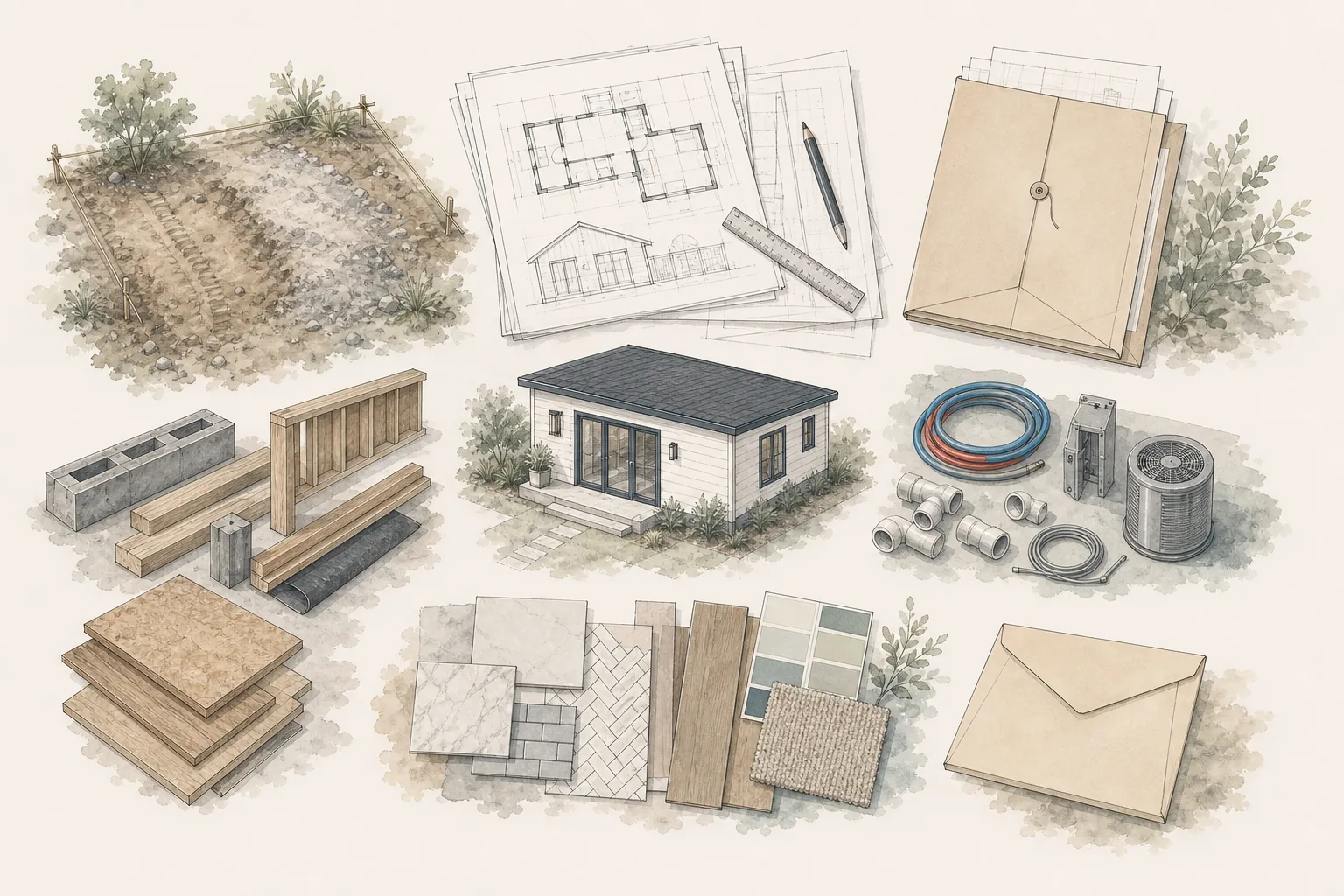
A lender or homeowner may begin with the ADU building price, but financing should be based on the complete project. Build the all-in ADU budget before comparing funding options.
Include:
- Feasibility, surveys and existing-condition investigation
- Design, engineering and energy documentation
- Permits, agency fees and utility coordination
- Demolition, grading, drainage and site preparation
- Foundations and building construction
- Water, sewer, electrical, gas and communications work
- Construction access, staging, craning or modular installation
- Interior finishes, appliances and owner-furnished items
- Landscaping, fences, paving and restoration
- Financing fees, interest and required reserves
- A contingency appropriate to the project’s uncertainty
Financing only the initial contract amount can leave the homeowner without funds for utility upgrades, permit corrections, allowances, change orders or work excluded from the builder’s proposal.
Cash
Using savings avoids loan interest, underwriting and lender-controlled draws. It can also simplify contractor payments and allow faster decisions.
However, committing too much cash can weaken emergency reserves and leave the household exposed if the project costs more than expected. Maintain separate funds for contingency, household emergencies and expenses that occur before reimbursement or loan proceeds are available.
Home Equity Line of Credit
A home equity line of credit, or HELOC, generally allows the homeowner to borrow against available equity as funds are needed. This can match a phased construction schedule and reduce interest on undrawn funds.
Potential tradeoffs include variable interest rates, lender limits, appraisal requirements, draw or access periods, fees and the possibility that the available line does not cover the complete project. Payments may change when rates or repayment terms change.
RenoFi Renovation Financing
RenoFi works with lending partners to offer renovation-focused financing that can evaluate borrowing capacity using the home’s estimated after-renovation value rather than only its current value. This may provide more borrowing capacity when an ADU is expected to add meaningful property value.
RenoFi’s current product options include a renovation HELOC as well as other home-equity and refinance structures. The exact product, interest-rate structure, loan amount and repayment terms depend on the participating lender and the homeowner’s qualifications.
An as-completed appraisal and detailed plans, specifications and construction budget may be required to support the projected value. Confirm ADU eligibility, owner-occupancy requirements, fees, appraisal assumptions, funding timing and whether funds are provided as a line of credit or a lump sum before relying on this option.
Home Equity Loan
A home equity loan generally provides a lump sum with a defined repayment schedule. It may offer more payment certainty than a variable-rate line.
The homeowner may begin paying interest on the entire amount before construction uses all the funds. Confirm whether the loan amount, closing timeline and payment structure fit the project schedule and existing debt obligations.
Cash-Out Refinance
A cash-out refinance replaces the existing mortgage with a larger loan and provides funds from the new loan proceeds.
This may consolidate borrowing into one mortgage, but it also changes the financing on the entire property. Compare the new interest rate, term, closing costs, total interest, mortgage insurance when applicable and effect on an existing favorable mortgage—not just the cash received.
Renovation Mortgage
Renovation mortgages can combine property financing and improvement costs under one loan structure. Funds are typically controlled and released through an approved draw process rather than paid to the homeowner all at once.
Fannie Mae identifies HomeStyle Renovation as a potential path for borrowers purchasing or refinancing a one-unit property and constructing or installing an ADU. HUD’s Section 203(k) program insures eligible mortgages that combine purchase or refinance financing with rehabilitation funds held and released for the work. Freddie Mac also identifies mortgage offerings that may finance, refinance, build or renovate eligible properties with ADUs.
Product availability and eligibility depend on the lender, borrower, property, scope and current program rules. Expect additional documentation, appraisal, contractor review, inspections and draw administration.
Construction-to-Permanent Financing
Construction-to-permanent financing may be relevant when building a new primary home with an ADU or completing a major project that fits the lender’s construction program.
The lender may approve plans, budget, contractor, schedule and draw milestones, then convert the construction financing to permanent financing after completion. Confirm whether the program applies to an ADU added to an existing property, a new property with an ADU or both.
Personal Loans and Unsecured Credit
Personal loans and other unsecured borrowing may close quickly and do not rely on property equity. They often provide smaller amounts, shorter repayment periods or higher rates than secured mortgage products.
They may be useful for a limited portion of a well-defined project, but relying on several short-term debts can create substantial monthly-payment pressure during construction.
Retirement-Account or Other Asset-Based Borrowing
Some homeowners consider borrowing against retirement accounts, securities or other assets. These choices can affect investment growth, taxes, employment-related repayment rules, margin risk and long-term financial security.
Review the consequences with qualified financial and tax professionals before using long-term assets to fund a construction project.
Combining Funding Sources
An ADU may be funded with a combination of cash, equity borrowing and renovation or construction financing.
A blended strategy should clearly identify:
- Which source pays each project phase
- When each source becomes available
- Minimum cash reserves
- Interest and fees during construction
- Whether one lender restricts additional liens or borrowing
- What happens if a draw is delayed
- How contingency costs will be paid
Do not assume a second funding source can be added after construction begins. Lien position, appraisal, underwriting and project status can affect availability.
Understand Loan-to-Value and Available Equity
Secured financing commonly depends on the relationship between the loan balance and the lender’s accepted property value. Existing mortgages and liens reduce the equity available to borrow against.
The lender may use current value, an as-completed appraisal or a program-specific calculation. The amount spent on the ADU does not guarantee an equal increase in appraised value.
The Appraisal May Control the Loan Amount
ADU appraisals can be challenging when the local market has few comparable properties or the proposed unit is unusual.
Ask the lender:
- Whether the loan uses current or as-completed value
- What plans, specifications and budget the appraiser needs
- How permitted and unpermitted existing spaces are treated
- How prefab, modular or manufactured ADUs are classified
- Whether the appraiser must identify comparable ADU properties
- What happens if the appraisal is lower than expected
Maintain a financing plan that can tolerate a reasonable value shortfall rather than treating the desired appraisal as guaranteed.
Rental Income Is Not Automatically Qualifying Income
Some mortgage programs may allow eligible ADU rental income to be considered in underwriting when specific property, occupancy, documentation and program requirements are met. Fannie Mae and Freddie Mac publish conditions governing when ADU rental income may be used.
A homeowner’s projected rent is not the same as lender-approved qualifying income. The lender may require an appraisal rent schedule, lease documentation, reserves, landlord experience or limits on how much income can be counted.
Separate the financing question from the investment question: verify what the lender will recognize, then independently test achievable rent, vacancy, operating costs, maintenance, insurance and taxes. The guide to ADU rental income, property value, and financial expectations provides a framework for that separate analysis.
Construction Draws Affect Cash Flow
Renovation and construction loans commonly release funds after documented work, inspections or milestone approval. Contractor deposits and supplier payments may be due before the lender reimburses the draw.
Before signing contracts, understand:
- The draw schedule and required documentation
- Who requests and approves each draw
- Inspection timing
- Retainage or holdback requirements
- Whether deposits and stored materials are eligible
- How change orders are funded
- The final completion and closeout requirements
The construction contract payment schedule and lender draw schedule should be coordinated. A mismatch can create a cash crisis even when the total loan amount is adequate.
Lender Requirements Can Affect the Project Team
A lender may review or approve the contractor, licenses, insurance, experience, contract, plans, budget and schedule. Some programs require consultants, inspections or specific contract forms.
Confirm these requirements before selecting a delivery method or paying nonrefundable deposits. A builder acceptable to the homeowner may not satisfy the lender’s program.
Prefab and Modular Financing Requires Early Coordination
Prefab, modular and manufactured ADUs can create financing questions about deposits, off-site fabrication, ownership of work in progress, transportation, installation, foundation scope, titling and whether the unit becomes real property.
Ask the lender and provider:
- When ownership transfers
- Whether off-site work is eligible for draws
- How deposits are protected
- What site work is financed separately
- How the unit will be appraised
- What completion documents are required
Do not assume a loan designed for site-built construction will accommodate a factory-payment schedule.
Compare the Total Cost of Borrowing
The lowest advertised rate may not produce the lowest total cost or best project fit.
Compare:
- Fixed or variable interest rate
- Loan term and monthly payment
- Origination, appraisal, title and closing costs
- Mortgage insurance or annual fees
- Interest charged before funds are used
- Draw, inspection and consultant fees
- Prepayment terms
- Effect on the existing mortgage
- Tax treatment as confirmed by a tax professional
- Total interest under realistic repayment assumptions
Also test whether the household can carry the payment without rental income, during vacancy and during a construction delay.
Maintain a Financing Contingency
Construction contingencies address project uncertainty. Financing contingencies address the risk that funds arrive later, cost more or are smaller than expected.
Plan for:
- Appraisal shortfalls
- Interest-rate changes before closing
- Loan fees not included in early estimates
- Delayed draws
- Change orders and allowance overruns
- Temporary housing or property disruption
- Vacancy after completion
- Higher insurance, utility, tax or maintenance expenses
Questions to Ask Potential Lenders
- Does this program finance a new ADU on an existing property?
- Does it cover detached, attached, conversion, prefab or manufactured ADUs?
- How is the maximum loan amount calculated?
- Is an as-completed appraisal required?
- Can projected or existing rental income be considered?
- What plans and permits are required before closing?
- How are contractors approved?
- How are deposits, draws and inspections handled?
- Which project costs are ineligible?
- What reserves or homeowner contributions are required?
- What happens if the project cost or schedule changes?
- When does permanent repayment begin?
Common Financing Mistakes
- Seeking financing before defining the complete project cost
- Assuming the ADU will increase value dollar for dollar
- Treating projected rent as guaranteed qualifying income
- Comparing only interest rates
- Failing to coordinate contractor payments with lender draws
- Using all available cash without preserving reserves
- Selecting a contractor before learning lender requirements
- Ignoring the effect of refinancing an existing low-rate mortgage
- Assuming prefab deposits will be reimbursed
- Financing the base unit but not site work and utilities
A Practical Financing Process
- Complete early feasibility
Confirm a realistic ADU path, property constraints and likely scope before paying for financing based on an unsupported concept.
- Build a complete budget
Include professional services, agency costs, site work, utilities, construction, financing expenses and contingency.
- Review household capacity
Evaluate income, existing debt, credit, equity, cash reserves and ability to carry payments without optimistic rent assumptions.
- Compare multiple funding structures
Request written terms and evaluate loan amount, payment, total cost, timing, draw process and effect on the existing mortgage.
- Coordinate lender and project requirements
Align plans, contractor selection, contract terms, deposits, schedule and draw milestones before committing.
- Stress-test the plan
Model appraisal shortfall, higher project cost, delayed completion, vacancy and lower rent.
- Close only with a clear funding map
Know which source pays each phase, how contingency will be funded and what documents release each draw.
How Foundation Can Help
Foundation can help homeowners define the complete ADU scope, organize early cost assumptions, identify lender and contractor coordination questions, compare project-delivery implications and prepare for productive discussions with licensed lenders and financial professionals.
Financial and Regulatory Note
This article provides general educational information, not individualized lending, investment, tax or legal advice. Loan products, underwriting rules, rates, fees and ADU eligibility change and vary by lender, borrower and property. Confirm current terms with licensed lenders and consult qualified financial, tax, legal and insurance professionals before making a financing decision.