
California law has made accessory dwelling units easier to approve on many residential properties, but that does not mean every ADU is automatically permitted—or that every property supports the same design.
State law establishes important rights and limits on how local agencies review ADUs. Cities and counties still administer permits, apply qualifying objective standards and enforce building, fire, energy, utility and property-specific requirements.
This guide explains the California ADU framework at a homeowner level. It is not legal advice or a substitute for current agency guidance, property research or qualified design and construction professionals.
What Is Considered an ADU in California?
California defines an accessory dwelling unit as an attached or detached residential dwelling located on the same lot as a proposed or existing primary residence. An ADU provides complete, independent living facilities, including permanent provisions for living, sleeping, eating, cooking and sanitation.
An ADU may take several forms:
-
A detached structure in a yard or another buildable portion of the property
-
An addition attached to the primary home
-
A conversion within the primary home
-
A converted garage or other qualifying accessory structure
-
A unit associated with an existing or proposed multifamily property
-
A manufactured home that meets the applicable statutory definition
A junior accessory dwelling unit, or JADU, is a separate category. Under current California law, a JADU is limited to 500 square feet of interior livable space and must be contained entirely within a single-family residence. It may have its own sanitation facilities or share them with the primary residence.
The distinction matters because ADUs and JADUs are subject to different requirements for size, location, facilities, occupancy and approval.
California Law Creates a Statewide Framework
California’s ADU laws are primarily contained in Government Code sections 66310 through 66342. These laws establish a statewide framework that local agencies must follow when reviewing ADU and JADU applications.
Among other protections, state law:
-
Requires qualifying ADUs and JADUs to be reviewed ministerially
-
Limits local agencies to objective standards
-
Establishes timelines for reviewing complete applications
-
Restricts certain parking, setback, size and owner-occupancy requirements
-
Protects several categories of ADUs that meet specific statutory criteria
-
Limits the use of unrelated zoning violations to block an ADU application
-
Requires written explanations when an application is denied
-
Gives the California Department of Housing and Community Development authority to review and enforce local compliance with State ADU Law
These protections are significant, but they do not eliminate the need for a coordinated design or a complete permit application.
Ministerial Approval Does Not Mean Automatic Approval
A ministerial review is conducted without a discretionary hearing or a subjective decision about whether the project is desirable. If the application satisfies the applicable objective requirements, the permitting agency must approve it.
This generally prevents an ADU from being subjected to a discretionary neighborhood hearing or evaluated using vague design preferences. It does not mean the project can ignore zoning, building, fire, structural, energy, utility or safety requirements.
The submitted documents must still demonstrate compliance with the standards that apply to the property and the proposed ADU.
Objective Standards Still Shape the Design
California law generally allows local agencies to apply objective standards. An objective standard can be evaluated using a defined and verifiable requirement rather than personal judgment.
Depending on the property and jurisdiction, objective standards may address:
-
Building height
-
Front, side and rear setbacks
-
Unit size
-
Lot coverage and floor-area limitations
-
Exterior access
-
Fire separation
-
Building-code compliance
-
Utility connections
-
Grading and drainage
-
Historic or environmental conditions
-
Design requirements that are stated objectively
State law restricts local standards that would effectively prohibit an ADU that the statute protects. However, determining which state protections apply—and how local standards interact with them—requires property-specific analysis.
The 800-Square-Foot Protection Is Important but Limited
One of the most discussed provisions of California ADU law protects the ability to construct certain ADUs of at least 800 square feet with four-foot side and rear setbacks, provided the project complies with other applicable requirements.
This protection can prevent local lot-coverage, floor-area, open-space, minimum-lot-size or similar standards from making an otherwise qualifying ADU impossible.
It should not be interpreted as a guarantee that an 800-square-foot ADU can be placed anywhere on a property. The project may still be affected by:
-
Front-yard requirements
-
Easements
-
Fire access and separation
-
Existing buildings
-
Utility locations
-
Drainage and grading
-
Coastal requirements
-
Historic resources
-
Environmentally sensitive conditions
-
Building-code limitations
-
Safe construction access
The protected size and setbacks are part of the analysis, not a substitute for complete feasibility review.
Height Rules Depend on the ADU and Property
California law establishes minimum height allowances that local agencies must recognize for certain ADUs.
Current state guidance describes a base allowance of at least 16 feet for qualifying detached ADUs. Greater height may be protected in some circumstances, including certain properties near qualifying transit or properties containing an existing or proposed multistory multifamily dwelling.
An attached ADU may be subject to a different height framework. State law limits how low a local agency may set the allowable height, but it does not necessarily require every attached ADU to be approved at the maximum possible height or with more than two stories.
Roof form, property location, relationship to the primary building, local standards and the specific statutory pathway can all affect the permitted height. Homeowners should verify the current requirements before choosing a one- or two-story concept.
Local Agencies Generally Have 60 Days to Review a Complete Application
When an ADU or JADU is proposed on a lot with an existing single-family or multifamily dwelling, the permitting agency generally must approve or deny a complete application within 60 days.
The 60-day period begins after the agency receives a completed application—not when a homeowner first contacts the agency or submits incomplete preliminary information.
If an application is denied, the permitting agency must generally provide written comments identifying the defective or deficient items and describing how the applicant can remedy them.
This review requirement does not guarantee permit issuance within 60 calendar days. The project may require applicant corrections, coordination with utilities or special districts, payment of fees or resolution of other incomplete items before the permit can be issued.
When an ADU is submitted with a proposed primary residence, the applications may be reviewed concurrently. The timing may then be connected to the review of the proposed primary dwelling.
Parking Cannot Be Required in Several Circumstances
California law restricts local agencies from requiring parking for ADUs in several situations. These protections can apply based on factors such as:
-
Proximity to public transit
-
Location within an architecturally or historically significant district
-
Creation of the ADU within an existing primary residence or accessory structure
-
Availability of on-street parking permits
-
Proximity to a car-share vehicle
-
Other conditions defined by current law
Replacement parking also cannot always be required when a garage, carport or covered parking structure is demolished or converted as part of an ADU project.
Parking rules remain property-specific. Coastal requirements, mapped conditions and the exact project configuration may affect the analysis. Homeowners should confirm the applicable requirements instead of assuming that parking is either always required or never required.
Owner Occupancy Is Generally Not Required for an ADU
Under current California law, local agencies generally cannot impose an owner-occupancy requirement as a condition of permitting an ADU.
JADUs are different. If a JADU shares sanitation facilities with the primary residence, owner occupancy is generally required; if it has separate sanitation facilities, owner occupancy generally cannot be required, subject to statutory exceptions.
Homeowners considering an ADU and JADU combination should understand which occupancy rules apply to each unit before selecting the project configuration.
Short-Term Rental Restrictions May Still Apply
California law generally allows local agencies to prohibit ADUs and JADUs from being rented for periods of 30 days or less.
An ADU should not be assumed to qualify automatically for short-term rental use. Local ordinances, licensing requirements, coastal restrictions, homeowners-association rules and other regulations may further affect rental use.
Homeowners evaluating an ADU primarily as an income-producing property should verify the permitted rental term and operating requirements before relying on projected revenue.
Impact Fees Depend Partly on Unit Size
State law restricts the impact fees that may be imposed on smaller ADUs. An ADU of 750 square feet or less is generally exempt from local agency, special district and water corporation impact fees as defined by the statute.
For an ADU larger than 750 square feet, qualifying impact fees must generally be charged proportionately in relation to the primary dwelling.
Impact fees are not the same as every cost associated with an ADU permit. Plan-review fees, building-permit fees, utility connection charges, capacity charges and other project costs may be governed by different rules.
A realistic budget should identify each expected fee rather than relying on a general statement that ADU fees have been waived.
Utility Requirements Depend on the Project Type
Utility treatment can differ depending on whether the ADU is:
-
Newly constructed
-
Attached or detached
-
Created by converting existing space
-
Developed with a new primary residence
-
Connected to public water and sewer
-
Served by a special district or private utility
Certain converted ADUs may receive statutory protections from requirements for new or separate utility connections. New detached construction may require a different connection and fee analysis.
Even when a separate meter or connection is not legally required, the existing system must still have adequate capacity and a workable route. Sewer depth, electrical service, water supply, trenching, drainage and equipment locations can materially affect feasibility and cost.
Existing Violations Do Not Always Block an ADU
A local agency generally may not deny an ADU or JADU application solely because the property has a nonconforming zoning condition, building-code violation or unpermitted structure that:
-
Does not present a threat to public health and safety
-
Is not affected by the construction of the proposed ADU or JADU
This protection is not permission to ignore dangerous conditions or incorporate unlawful construction into the new project. Conditions that threaten health and safety or are directly affected by the ADU work may still need to be corrected.
California law also provides a separate process affecting certain unpermitted ADUs and JADUs constructed before January 1, 2020. The agency’s ability to deny a permit to legalize one of these units is limited, subject to findings involving substandard building conditions and health or safety.
Legalizing an existing unit should begin with documentation of the structure, its apparent age, utilities and current condition. Homeowners should avoid assuming that prior construction will be accepted without investigation or corrective work.
Fire Sprinkler Requirements Are Limited by State Law
An ADU generally cannot be required to have fire sprinklers if sprinklers are not required for the primary residence.
Constructing an ADU also generally cannot be used by itself to trigger a requirement to install fire sprinklers throughout the existing primary dwelling.
This does not eliminate other fire and life-safety requirements. Building separation, wall and opening protection, emergency access, fire-department access, alarms and construction type may still affect the project.
Coastal and Historic Properties Require Additional Care
State ADU law applies in California’s coastal zone, but it does not supersede the California Coastal Act. A coastal development permit or additional coastal review may still be required.
Historic resources and architecturally significant districts may also introduce qualifying objective standards or additional documentation.
These conditions do not automatically prevent an ADU. They can change the approval path, design limitations, timeline and required professional work. Coastal, historic and environmental conditions should be identified before the homeowner commits to a design.
Homeowners Associations Cannot Simply Prohibit ADUs
California law limits private restrictions that would effectively prohibit or unreasonably restrict the construction or use of an ADU or JADU on qualifying property.
A homeowners association may be able to apply reasonable restrictions, but those restrictions cannot unreasonably increase the cost of construction, effectively prohibit the project or extinguish the ability to construct the unit. State guidance also explains that an HOA cannot become part of the local agency’s permit-approval process.
Properties governed by covenants, conditions and restrictions should still be reviewed carefully. Homeowners may need legal guidance to understand how state law applies to a particular association rule or enforcement position.
Local Rules Still Matter
Cities and counties may adopt their own ADU ordinances, but those ordinances must comply with State ADU Law. A local agency is not required to adopt a standalone ADU ordinance; when it does, the ordinance must be submitted to the California Department of Housing and Community Development for review.
Local requirements may add important information about:
-
Application forms and submittal procedures
-
Property zoning and mapped overlays
-
Permitted configurations
-
Objective design standards
-
Utility and special-district coordination
-
Fire-department review
-
Coastal or historic processes
-
Grading, drainage and environmental requirements
-
Plan-check fees and other charges
-
Inspection and closeout procedures
A local ordinance or information bulletin can become outdated when state law changes. Homeowners and project teams should confirm that the guidance they are using reflects the current statute and the agency’s current procedures.
What State ADU Law Does Not Decide for You
State law may establish that an ADU is allowed, but it does not determine whether the project is practical, affordable or well suited to the homeowner’s goals.
It does not decide:
-
Where the ADU should be located
-
Whether attached, detached or converted space is the best approach
-
Whether existing utilities have sufficient capacity
-
How much site work will be required
-
Whether the proposed layout will function well
-
How construction will affect the occupied property
-
Whether the complete budget makes sense
-
Which professionals should be hired
-
Which proposal provides the most complete scope
-
Whether anticipated rent or property value justifies the investment
Those decisions require a combination of property research, design, technical investigation, budgeting and homeowner judgment.
A Practical Order of Operations
Homeowners can reduce avoidable redesign by approaching California ADU planning in the following order:
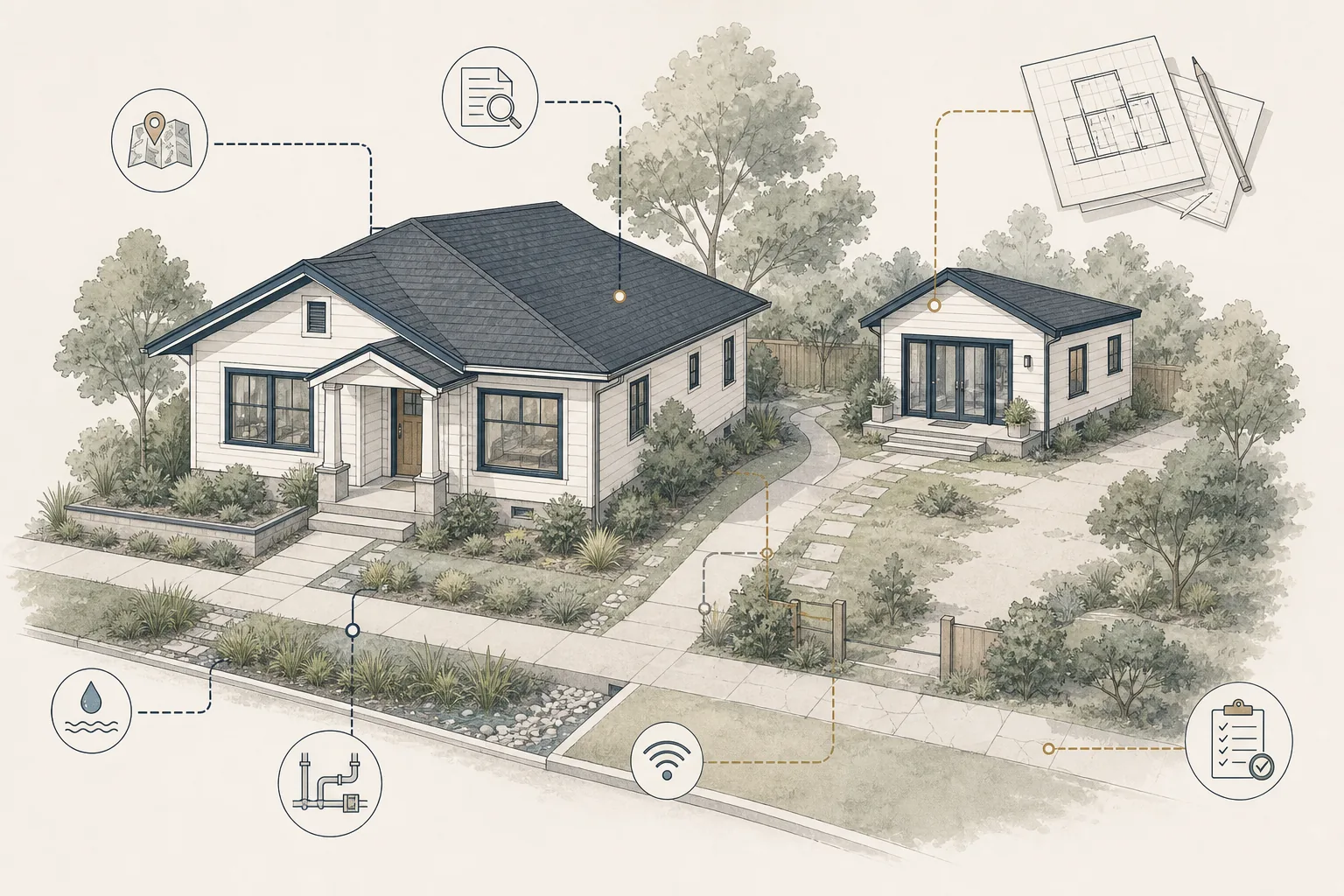
1. Confirm the governing jurisdiction
Identify the city or county responsible for the property and the other agencies that may participate in the review.
2. Define the intended use
Clarify who will occupy the ADU, the desired privacy and accessibility, possible future uses and whether rental income is part of the decision.
3. Research the property
Confirm zoning, mapped overlays, existing legal structures, easements, utilities, fire conditions, access, drainage and other constraints.
4. Identify the likely statutory pathway
Determine whether the project is attached, detached, converted, a JADU or part of a multifamily property and which state protections may apply.
5. Establish preliminary feasibility
Evaluate possible size, location, setbacks, height, access, utility routes, site work and required technical studies before completing the design.
6. Build the full budget framework
Include design, engineering, surveys, permits, agency fees, utilities, site work, construction, temporary conditions, contingency and ongoing costs.
7. Develop coordinated permit documents
Make sure responsibilities are defined across architecture, structure, energy, fire, utilities, civil work and other required disciplines.
8. Verify current requirements before submission
State laws and local procedures change. Confirm the applicable requirements again before relying on the final design or submitting the application.
How Foundation Can Help
Foundation Renovation Coaching helps homeowners understand and organize the decisions that come before design, permitting and construction.
For homeowners considering an ADU, Foundation can help:
-
Clarify the intended use and long-term goals
-
Organize the property and agency questions that require confirmation
-
Compare attached, detached and conversion approaches
-
Develop a complete preliminary budget framework
-
Identify likely professional and technical needs
-
Prepare for conversations with designers, engineers and builders
-
Review proposals for assumptions, exclusions and unclear responsibilities
-
Create a more organized path from initial idea to professional design
For homeowners who need deeper pre-design due diligence, the Foundation Feasibility Report™ can organize preliminary findings related to property conditions, likely constraints, agency questions, project scope and next steps.
Foundation does not provide legal advice, architectural or engineering services, permit approval or guarantees about what a jurisdiction will allow. Property-specific conclusions must be confirmed by the applicable agencies and qualified professionals.
California Law Creates Opportunity—Good Planning Makes It Usable
California’s ADU framework has removed many barriers that once prevented homeowners from creating accessory housing. Ministerial review, objective standards, protected ADU categories and limits on certain local restrictions provide meaningful opportunities.
Those opportunities still need to be translated into a buildable project.
A successful ADU begins by connecting the homeowner’s goals with the property, the current state and local rules, the complete scope and a realistic financial plan. State law may open the door, but careful due diligence determines whether the project can move through it successfully.
Jurisdiction and Legal Note
This article provides general educational information based on current California guidance. ADU laws, agency interpretations and local procedures may change. Requirements also vary based on jurisdiction, property conditions and project type.
Homeowners should verify current requirements with the applicable state and local agencies and seek advice from qualified legal, design, engineering, tax, insurance and construction professionals as appropriate. Nothing in this article is legal advice.