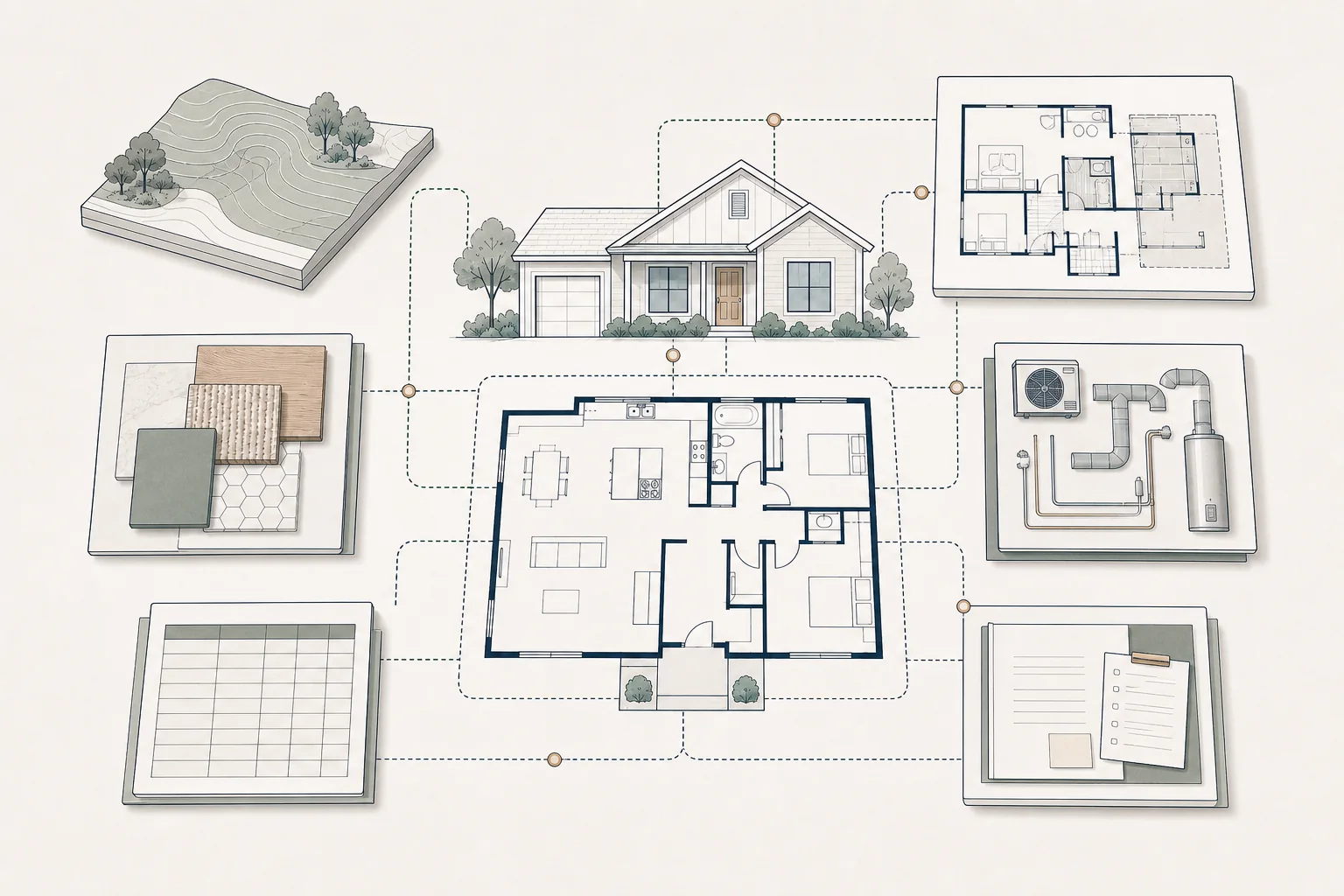

A renovation budget is not only a spending limit, and a project scope is not only a list of rooms. Useful planning connects goals, existing conditions, design decisions, professional services, approvals, construction, owner purchases, household impacts and unresolved risk.
This guide helps homeowners understand how budget, scope and priorities work together. Use it as a navigation hub: begin with the decision that is creating uncertainty, then continue to the focused guide for that topic.
The central planning question
A realistic renovation plan answers three connected questions:
-
What outcomes matter most to the household?
-
What complete scope is required to achieve those outcomes?
-
What resources and uncertainty can the household responsibly accept?
If one answer changes, the others may need to change. Increasing the scope can affect professional services, approvals, utilities, construction time, temporary living and contingency. Reducing a visible finish allowance may not solve a budget problem caused by structural work or site conditions. A phasing decision may reduce the current construction scope while adding duplicated work later.
The goal is not to predict every detail at the beginning. It is to make commitments at the level of confidence supported by the information available.
Choose the guide that matches your decision
Understand what drives renovation cost
Start with How Much Does a Home Renovation Really Cost? when you need to understand why useful pricing depends on more than square footage or a generic online range.
That guide explains how cost is shaped by:
-
Project type and scope.
-
Existing conditions and investigation.
-
Design complexity and documentation.
-
Structural, utility and building-system work.
-
Site access and construction logistics.
-
Permits and agency requirements.
-
Product, finish and procurement decisions.
-
Pricing assumptions, exclusions and market conditions.
Use it before treating an early estimate as a commitment.
Build the complete project budget
Start with How to Create a Realistic Renovation Budget when you need a method for tracking the complete homeowner cost rather than only the contractor’s construction price.
A complete budget may need to address:
-
Planning, design and professional services.
-
Surveys, testing and technical investigations.
-
Permits, reviews and utility coordination.
-
Construction and contractor-managed work.
-
Owner-purchased products, furnishings and equipment.
-
Temporary housing, moving, storage and household logistics.
-
Insurance, financing or professional advice where applicable.
-
Project-specific uncertainty and approved changes.
-
Closeout, restoration and remaining owner obligations.
Not every category applies to every project. The point is to identify what belongs in the decision before comparing the total against available resources.
Plan for uncertainty
Use How Much Contingency Should You Budget for a Renovation? when the concern is how to prepare for incomplete information, existing conditions or decisions that may change.
There is no universal contingency percentage that is appropriate for every project. The amount and structure of a reserve should respond to:
-
The age and condition of the home.
-
The investigations completed.
-
How developed and coordinated the design is.
-
How many selections and product decisions remain open.
-
The quality and completeness of pricing information.
-
Known site, structural, utility or permitting uncertainty.
-
The household’s ability to absorb cost and schedule changes.
Contingency is not a substitute for investigation, design or clear scope. It is one tool for managing uncertainty that remains after reasonable planning.
Decide whether to phase the project
Use Should You Renovate Everything at Once or Phase Your Project? when the household is comparing one coordinated construction period with multiple stages.
Phasing can preserve flexibility, spread decisions or allow some areas to remain in use. It can also duplicate:
-
Design and permit work.
-
Mobilization and site protection.
-
Demolition and temporary construction.
-
Trade work and system shutdowns.
-
Finish transitions and restoration.
-
Storage, moving and household disruption.
The right comparison is not one large price versus one smaller phase. It is the complete path to the intended end state, including work that must be designed now even if it is built later.
Balance financial value and quality of life
Use Renovation ROI vs. Quality of Life: How Should You Decide? when resale considerations are competing with comfort, function, location or long-term household goals.
A renovation decision may include:
-
Daily function and reduced frustration.
-
Accessibility or changing household needs.
-
Maintenance and reliability.
-
Energy, comfort or system performance.
-
Expected time in the home.
-
Neighborhood and location preferences.
-
Resale considerations supported by qualified local advice.
-
The financial effect of renovating, moving or delaying.
Foundation does not predict property value or investment return. The purpose of this pathway is to make the homeowner’s decision criteria visible rather than allowing one unsupported number to control the plan.
Prioritize the wish list
Use How to Prioritize Your Renovation Wish List When the Budget Is Limited when the desired scope is larger than the available budget or tolerance for disruption.
A practical prioritization process distinguishes:
-
Problems that must be addressed for the project to function.
-
Work that protects or enables other work.
-
Goals that create the greatest household benefit.
-
Items that would be difficult or wasteful to add later.
-
Choices that can be deferred without blocking the long-term plan.
-
Preferences that should remain optional until reliable pricing is available.
Prioritization is not simply cutting the most expensive item. Removing one component can affect layout, systems, permits, sequencing and the value of other work. Test each change against the complete project.
How budget and scope should develop together
1. Define the outcomes
Describe the problems the renovation should solve and the conditions the household wants to improve. Separate outcomes from preselected solutions.
2. Establish the preliminary scope
Identify the rooms, systems, site areas and professional work that may be affected. Record what is included, excluded, optional and unresolved.
3. Gather property information
Collect available plans, permits, surveys, reports, utility information and maintenance history. Assign critical existing-condition questions to appropriately qualified professionals.
4. Build the complete budget structure
Create categories for the entire homeowner commitment before inserting numbers. This helps reveal missing categories and prevents a construction estimate from being mistaken for the total project budget.
5. Align design and pricing
As the design becomes more developed, update quantities, selections, assumptions and technical requirements. Pricing should become more reliable as the scope becomes more defined and coordinated.
6. Document tradeoffs
When the plan exceeds the budget or risk tolerance, record the proposed change, expected benefit, dependencies, secondary effects and decision owner.
7. Maintain a current baseline
Once the household approves a direction, preserve a dated baseline for scope, budget assumptions, allowances, exclusions and unresolved risks. Changes should be compared against that baseline rather than against memory.
Questions to answer before relying on a renovation estimate
-
What documents and scope information were used?
-
What areas, systems and site work are included?
-
Which professional services, permits and fees are excluded?
-
Which products or selections are allowances?
-
What owner purchases or responsibilities remain outside the estimate?
-
What existing conditions were investigated?
-
What assumptions were made about utilities, access and work hours?
-
What design decisions remain open?
-
What potential changes are already visible but not priced?
-
Does the estimate represent construction only or the complete project budget?
-
How will the estimate be updated as information improves?
A lower estimate is not necessarily the better plan if it excludes work another estimate includes or relies on assumptions the property cannot support.
Common planning mistakes
-
Starting with a desired number and forcing an undefined scope into it.
-
Comparing contractor prices before aligning scope and assumptions.
-
Treating allowances as firm product budgets.
-
Using a universal contingency percentage without evaluating project risk.
-
Reducing finishes while ignoring site, structural or utility cost drivers.
-
Phasing work without designing the intended end state.
-
Leaving owner purchases and temporary living outside the budget.
-
Making value decisions from generic resale claims.
-
Failing to record what changed and why.
Where Foundation can help
A Foundation Strategy Session™ helps organize the project’s goals, priorities, preliminary scope, budget assumptions, major risks and next steps. The written Foundation Renovation Roadmap™ provides a project-specific framework for the decisions that should come next.
When property conditions or competing project approaches require deeper preliminary review, a Foundation Feasibility Report™ can organize available records, identify major constraints and document questions that require confirmation by agencies or licensed professionals.
Once plans exist, a Foundation Plan Review™ can help organize questions about alignment, missing information, constructability concerns and value opportunities without replacing architectural, engineering, code or professional technical review.
Foundation remains independent. It does not sell design or construction, maintain a preferred-provider list, accept referral compensation or guarantee another professional’s price or performance.
Frequently asked questions
Should I set the budget or scope first?
They should develop together. The household needs an initial financial boundary, but reliable scope decisions also require information about the property, design and complete project cost. Treat both as working assumptions until they are supported by better information.
Is the contractor’s price the renovation budget?
Not necessarily. A contractor’s price reflects the work and terms included in that proposal. The homeowner’s complete project budget may also include planning, design, consultants, permits, owner purchases, temporary living and other obligations.
How accurate should an early renovation estimate be?
Accuracy depends on the information available. Early estimates can help compare directions, but they should identify their basis, exclusions, assumptions and expected refinement. Do not require a level of certainty the scope and design cannot yet support.
Should every project have contingency?
Most renovations contain some uncertainty, but the appropriate reserve and risk strategy are project-specific. Some risks should be investigated, designed or transferred through clear scope rather than simply covered with more money.
How do I reduce the project without undermining it?
Begin with priorities and dependencies. Protect work that solves the core problem, enables later phases or would be disruptive to repeat. Evaluate the effects of each reduction on design, systems, approvals, sequence and long-term plans.
Can Foundation tell me what I can afford?
Foundation can help organize project information, budget categories, assumptions and tradeoffs. It does not provide financial, lending, tax, investment or affordability advice. Those conclusions belong to the homeowner and qualified financial professionals.
Build a plan that can support the next commitment
A useful renovation plan does not eliminate every unknown. It identifies what is known, what remains uncertain, who must confirm it and how the household will respond if the assumptions change.
Use this hub to choose the budget, scope or priority decision that needs attention now. Then return as the project moves from early planning into design, pricing and construction preparation.
Foundation provides educational renovation planning and decision support. Content is general and does not replace project-specific architectural, engineering, contracting, inspection, legal, financial, tax, real-estate, environmental, safety or jurisdictional advice.