Why Renovations Reveal Surprises
Plans, inspections, exploratory openings, and contractor experience can reduce uncertainty, but they cannot expose every condition inside walls, below floors, above ceilings, or underground. Existing homes may also contain undocumented repairs or changes made under older standards. The discovery itself is not proof that planning failed; the key is how the team evaluates and resolves it.
Common Unexpected Discoveries
- Water intrusion, rot, corrosion, or pest damage hidden by finishes.
- Framing, foundations, or structural connections that differ from available plans or assumptions.
- Outdated, damaged, or improperly installed plumbing, electrical, or HVAC components.
- Previous work completed without permits or in conflict with current project requirements.
- Potential asbestos, lead, mold, or other environmental concerns requiring qualified evaluation.
- Unknown utilities, unsuitable soil, buried materials, or other concealed site conditions.
- Dimensions, assemblies, or material layers that differ from what could be observed before demolition.
First: Pause, Protect, and Document
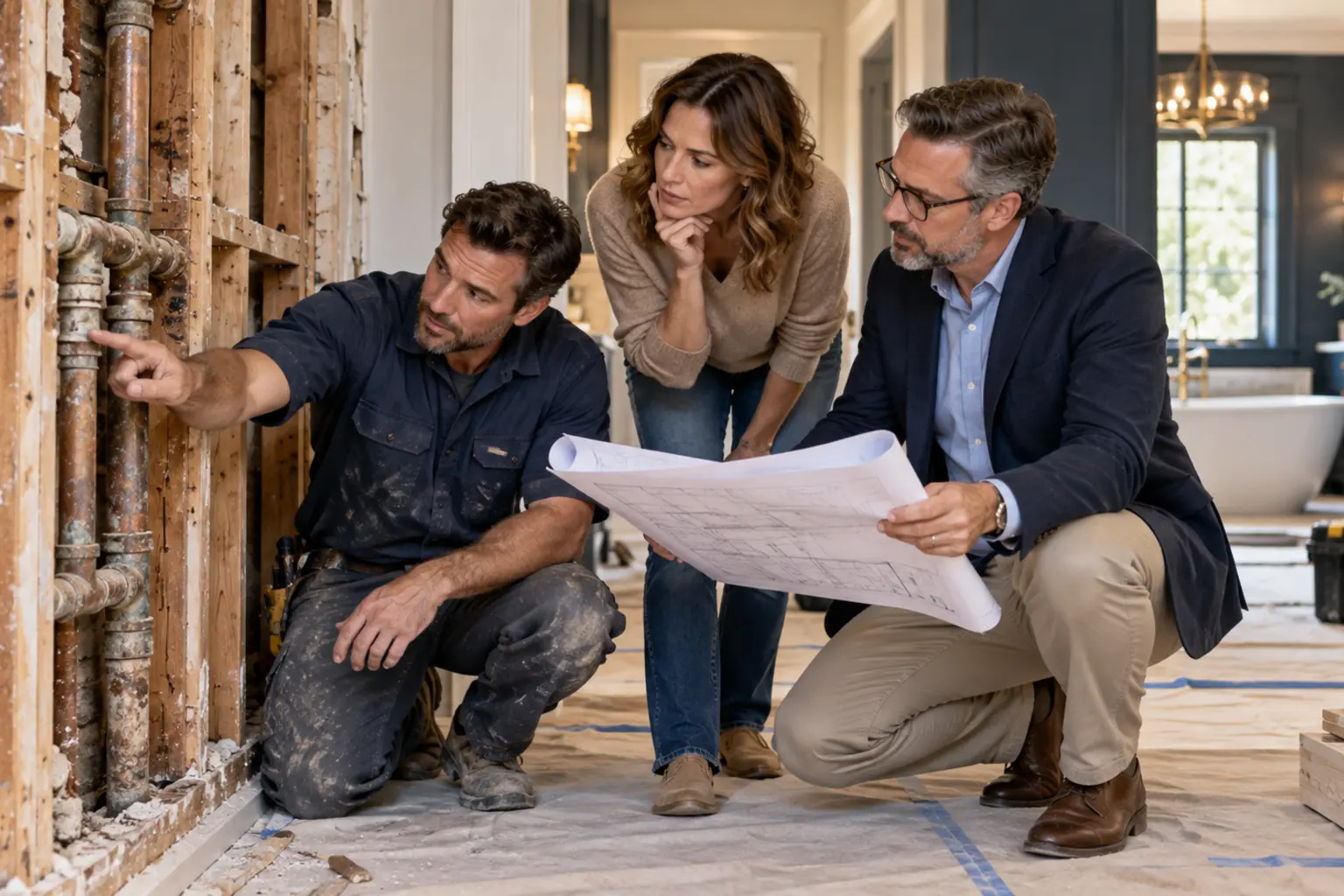
The affected work should pause long enough to prevent damage, unsafe exposure, or work that may need to be removed later. The contractor should protect the area and document what was found with photographs, measurements, and a written description. Unrelated work may be able to continue if it can proceed safely and will not limit the available solutions.
Do Not Diagnose from a Photograph Alone
A photograph can show that a condition exists, but it may not establish the cause, extent, or correct repair. Structural concerns may require an engineer; suspected hazardous materials may require testing; moisture or pest damage may require specialized evaluation. Avoid disturbing a potentially hazardous material until the appropriate professional determines the next step.
Separate Facts from Assumptions
Before selecting a solution, identify what is known, what is suspected, and what additional information is needed. A focused investigation may include opening a limited additional area, testing material, tracing a leak, reviewing permit history, or obtaining a design detail. The investigation should be proportionate to the risk and should clarify the decision rather than expand demolition without a purpose.
Define the Decision Before Comparing Solutions
Once the condition is understood, the team should explain the decision that must be made. Is the goal to meet a safety or code requirement, restore damaged work, correct the source of a problem, protect long-term performance, or preserve the intended design? A clear objective makes it easier to compare alternatives fairly.
Evaluate Reasonable Options
There may be one required response or several acceptable approaches. For each option, consider immediate cost, service life, future access, maintenance, appearance, risk of recurrence, effect on adjacent work, and compatibility with the planned renovation. The least expensive repair is not always the best value, but a broad upgrade is not automatically necessary simply because a wall is open.
Understand What Is Required and What Is Recommended
Ask the project team to distinguish required correction from recommended improvement and optional upgrade. Code, safety, engineering, manufacturer instructions, or permit conditions may limit the choices. Recommendations may reduce future risk without being mandatory. Optional work should be evaluated against the homeowner's goals and remaining contingency rather than bundled into the required repair without explanation.
Evaluate the Full Cost and Schedule Effect
The repair may involve more than the visible condition. Investigation, design, testing, permits, protection, demolition, disposal, reconstruction, inspections, and related trade work can all affect cost. Schedule impact may depend on professional review, agency approval, material availability, or the point at which the project can safely resume. Ask what work is directly affected and whether other areas can continue.
Use Contingency Deliberately
Contingency is a planning reserve for uncertainty—not an extra allowance that must be spent. Track the estimated and approved cost of the discovery, the remaining reserve, and other unresolved exposure. If the condition consumes a meaningful portion of the contingency, revisit lower-priority upgrades or future decisions before committing the remaining funds.
Confirm Responsibility Through the Contract
The construction contract should describe how unforeseen conditions, investigation costs, emergency work, schedule extensions, and changes are handled. Responsibility may depend on the contract language and the specific facts. Avoid assuming that a concealed condition is automatically the homeowner's or contractor's fault. If responsibility or coverage is disputed, obtain appropriate professional, insurance, or legal guidance.
Document the Resolution
Record the condition, supporting evaluation, selected response, responsible parties, cost, and schedule effect. If the resolution changes the contract, plans, or specifications, complete the required written approval before permanent corrective work proceeds whenever practical. Save test results, photographs, field reports, revised details, inspection records, and warranties with the project closeout documents.
A Practical Response Process
- Pause and protect the affected area.
- Document what is visible without making an unsupported diagnosis.
- Identify the qualified person needed to evaluate the condition.
- Determine what is known and what investigation is still required.
- Define the objective and compare reasonable response options.
- Review cost, schedule, risk, and contingency; then document the approved resolution.
- Verify the correction before concealment.
Coach's Perspective
Unexpected discoveries create urgency because the project may be waiting for an answer. Urgency should shorten the communication cycle, not eliminate the decision process. Ask what must happen immediately, what information is still needed, and the latest responsible time for a decision. This keeps the team moving without turning an incomplete explanation into an automatic approval.
Questions to Ask When Something Is Discovered
- What exactly was found, where, and how much of it is visible?
- Who is qualified to determine the cause, extent, and required response?
- What investigation is needed, and what will it tell us?
- Which work is required, recommended, or optional?
- What alternatives exist, and what risks or tradeoffs come with each?
- What are the cost and schedule effects, and how will the correction be verified?
Common Misconceptions
A good contractor should have predicted every concealed condition. Experience and investigation reduce uncertainty, but existing construction cannot always be fully known before demolition.
The entire surrounding area must be replaced once a problem is found. The appropriate extent should be based on evidence, professional guidance, code, performance, and the homeowner's goals—not fear alone.
Work must stop everywhere until the issue is resolved. The affected path may need to pause, while unrelated work may continue if it is safe and does not compromise the solution.
Foundation Tip
Before approving a solution, ask for a concise summary of what was found, what remains unknown, the available options, and each option's cost and schedule effect. This turns a stressful surprise into a reviewable decision.
Closing Thought
Planning cannot eliminate every renovation surprise, but it can provide a structure for responding well. When the team gathers the right facts, compares proportionate solutions, and documents the decision, an unexpected discovery becomes a manageable project issue rather than a crisis.